
Shadow AI Is Now a Breach Vector
Your staff are already pasting company data into public AI tools. That is a new exfiltration channel your existing security stack was never built to see. Here is how to find it and close it.
The channel nobody is monitoring
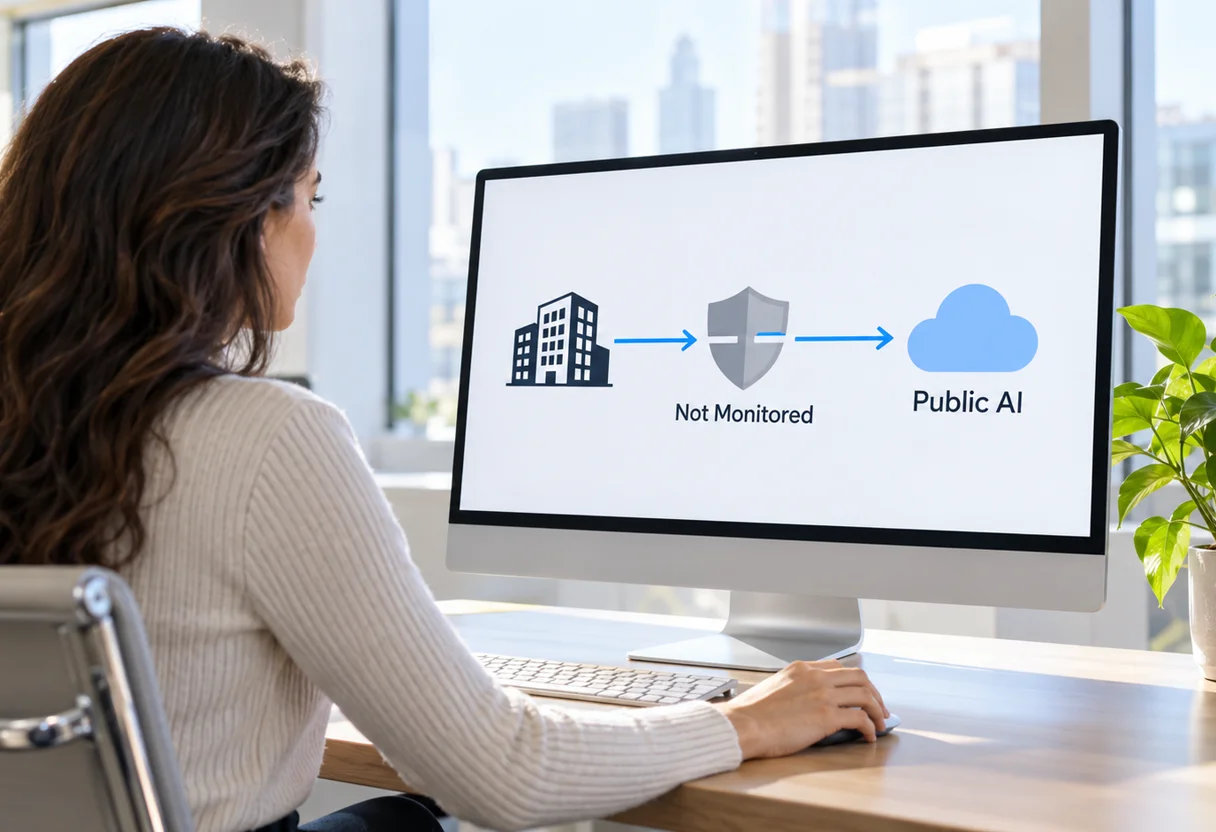
Your people are already pasting company data into public AI tools. That traffic leaves your network, lands on a third party's servers, and never shows up in your DLP, your firewall logs, or your SIEM. It is an egress channel you did not open and are not watching. Security teams spend years locking down email, USB, and cloud storage, and then a whole new exfiltration path opens through a browser tab.
What the breach data already shows
This is not theoretical. Cyberhaven Labs found that 27 percent of what employees paste into AI tools is sensitive data: source code, customer records, financials, internal strategy. IBM's 2025 Cost of a Data Breach report found that one in five breached organizations traced the incident to shadow AI, meaning AI tools in use without approval or oversight, and those breaches added roughly 670,000 dollars to the average cost. Gartner projects that by 2027, 40 percent of AI-related breaches will trace back to cross-border generative AI misuse.
See the risk in two minutes
The short version, in plain terms:
Find what is already leaving
The first job is visibility. You cannot govern a channel you cannot see. We help you identify which AI tools are in use, who is using them, and what classes of data are going out. That turns an invisible egress path into something you can measure and put policy around. Blocking the tools outright rarely works. It pushes usage to personal devices and deeper into the shadows, which is how you end up in the breach statistics above.

Close the channel with private, on-premises AI
The durable fix is to remove the egress path, not just watch it. Open-weight models are now capable enough for most business tasks and can run on hardware you own, on your network, behind your access controls. The model, the data, and the processing all stay inside your perimeter. There is no third-party provider to trust and no border for the data to cross. Our Reservoir package delivers exactly this, sized to your workload.
Guardrails from day one
Running AI in-house does not remove the need for controls. It lets you own them. We build on the NIST AI Risk Management Framework and the OWASP Top 10 for large language models, and we test the deployment the way an attacker would: prompt injection, guardrail bypass, and data leakage through the context window. Security is part of the architecture, not something bolted on after go-live.
Where to start
Get a security assessment. We map what your team is already sending to public AI, where the exposure sits, and what belongs in-house. You get a scored read of the risk and a concrete plan, not a vague warning. That is the fastest path from an invisible problem to a controlled one.
Frequently asked questions
How do we detect shadow AI in our environment?
We help you identify which AI tools are in use, who is using them, and what classes of data are leaving. Most organizations have no visibility here because the traffic does not resemble classic exfiltration. We turn that invisible channel into something you can measure and govern.
Is AI data exfiltration covered by our existing DLP?
Usually not well. Traditional DLP watches email, endpoints, and cloud storage. Data pasted into a browser-based AI tool often slips past those controls, which is exactly why shadow AI now shows up in breach data. It needs its own review.
Does on-premises AI satisfy our compliance auditor?
Running the model on infrastructure you control keeps sensitive data inside your perimeter, which addresses the data-residency and third-party-processing concerns auditors focus on. We pair it with NIST AI RMF and OWASP LLM controls so the deployment stands up to review.
Can we keep using AI without the breach risk?
Yes. Banning the tools pushes usage underground. The better path is capable open-weight AI on your own hardware, so staff get the productivity without sending data to a third party. Our Reservoir package is built for this.
Where do we start?
With an assessment. We map current AI usage and data exposure, then give you a scored risk read and a plan for what to keep in-house. We are based in Frisco, TX, work on-site across Dallas-Fort Worth, and handle clients elsewhere remotely. Call (888) 382-7685.
Find out what is already leaving
Book a security assessment. We map your current AI exposure and give you a scored risk read with a concrete plan. No commitment, no pressure.
Schedule a Consultation